ISSUE 01 Music
Fieldnotes11 MIN READ
Everyone’s Famous Somewhere
Streaming has expanded our listening worlds without erasing their common center. Hits can lose market share even as listeners share more music in absolute terms. An enormous audience therefore need not produce universal recognition: listening to the same artist does not mean that artist occupies the same place in everyone’s cultural world.
You come across an artist you barely know, open Spotify, and see 35 million monthly listeners. The number suggests a star. Yet you cannot name another song. Your friends have never mentioned the artist. The music does not seem to exist in the same public world as a Taylor Swift album, a Kendrick Lamar diss track, or a song that follows you from TikTok to the grocery store to a stranger's car.
How can someone be that big and still not feel famous?
We usually answer with one word: fragmentation. Algorithms sorted everyone into separate bubbles, the story goes, and the monoculture died. Each of us now inhabits a private feed where an artist can become enormous without crossing into anyone else's world.
It is an intuitive explanation. The actual listening data tells a stranger story. Hit music really does account for a smaller share of total consumption than it did earlier in the streaming era. But research on Spotify adoption reveals a more interesting pattern. People listen to much more music, spread that listening across a broader repertoire, and can even consume more of the same content as other users.
The better explanation is that the denominator got bigger. The mainstream still exists, but it occupies a smaller part of much larger personal listening worlds. In that environment, an artist can achieve extraordinary scale inside particular audiences without achieving equally broad cultural recognition.
I. Yes, the mainstream really did get smaller
The claim that music has fragmented often bundles together several different ideas. Some refer to the number of tracks released. Others refer to genres, languages, recommendation systems, or the disappearance of universally recognized stars. There is a narrower claim we can establish much more cleanly: a small group of leading tracks now accounts for a substantially smaller portion of all listening.
BPI annual data reported by MIDiA shows that the UK's top 100 tracks captured 10.3 percent of annual audio streams in 2016. That share fell every year through 2023, when it reached 3.7 percent, before increasing slightly to 3.8 percent in 2024.
Hits remain powerful. Three or four percent of a national streaming market is still an extraordinary amount of attention for 100 tracks to capture. Blockbuster releases can dominate charts, drive conversation, and temporarily pull consumption toward the center.
The UK’s top 100 tracks capture a much smaller share of listening
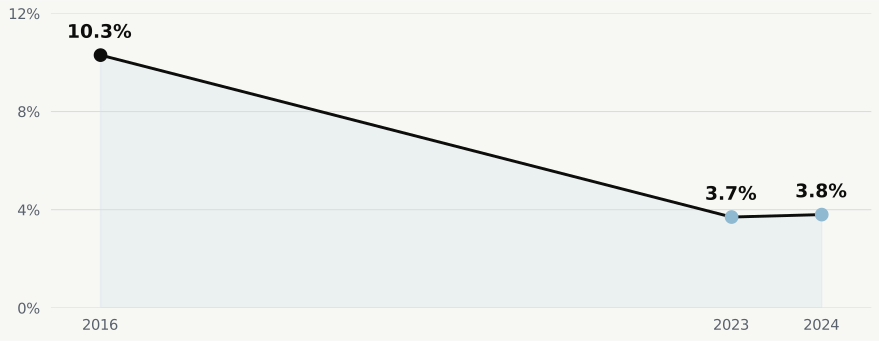
Source: BPI annual data reported by MIDiA Research1. The share fell every year from 2016 through 2023, then increased by 0.1 percentage point in 2024.
The small increase in 2024 also matters. It interrupts the temptation to treat fragmentation as a permanent law that moves in only one direction. MIDiA offers several possible explanations for the reversal, including an unusually strong superstar release cycle and changes in platform or consumer behavior, but the data does not identify which explanation caused it.
Hits still exist, but they explain less of the total listening market. The rest of the market is not merely an inactive long tail. Luminate's 2025 global streaming pyramid found that 541,000 tracks with between 1 million and 50 million global audio streams collectively generated 49.4 percent of on-demand audio volume2. Between the biggest hits and the barely played catalog sits an enormous middle of recordings with measurable audiences. The most useful description, then, is not that the monoculture disappeared. It is that the mainstream became a smaller layer inside a much larger listening field.
But market share is an aggregate measure. It tells us how much consumption the top tracks captured across a country. It does not tell us whether you and I stopped listening to the same artists. Those are different questions.
II. But are we actually listening in bubbles?
Market fragmentation asks
What percentage of total listening goes to the top songs or artists?Listener isolation asks
How much music do two people still have in common?A decline in the first does not logically establish a decline in the second. One reason is that streaming changed how much music could fit into an individual listener's life.
In a study published in Marketing Science, Hannes Datta, George Knox, and Bart Bronnenberg examined how adopting Spotify changed listening behavior. They collected 2.5 years of listening histories for 5,003 users across digital music platforms, matched adopters to non-adopters, and used a difference-in-differences design to compare changes around adoption.
The effects were substantial. At least six months after adopting Spotify, weekly play counts were still 49 percent higher. Listeners distributed their consumption across a wider set of artists, songs, and genres. Their concentration around personal favorites declined, and they discovered more new music.
Spotify adoption expanded personal listening
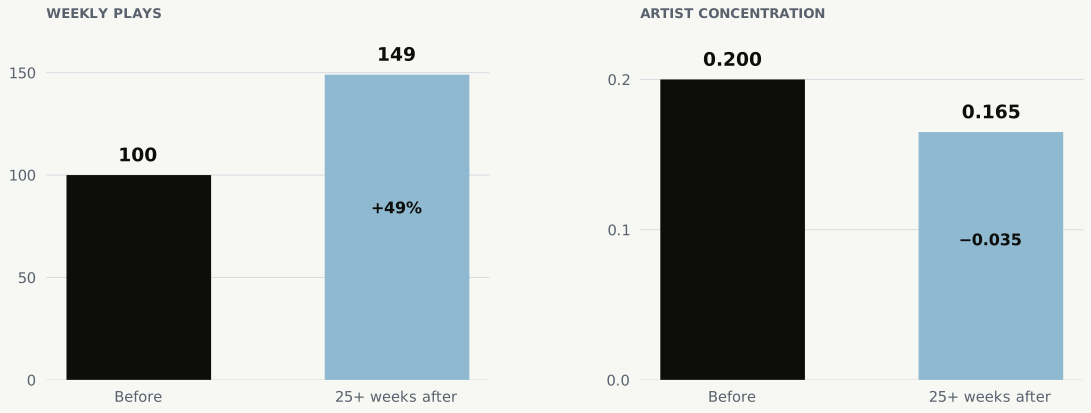
Author adaptation of long-run estimates from Datta, Knox, and Bronnenberg3. Long run means 25 or more weeks after adoption. The post-adoption artist HHI shown is the 0.200 pre-adoption baseline minus the estimated 0.035 effect. Adoption was not randomly assigned, so the estimates depend on the study's matching and difference-in-differences assumptions.
“More diverse” needs a definition here. The study was not claiming that listeners developed more sophisticated taste or crossed greater aesthetic distances. It measured breadth across artists, songs, and genres, as well as lower concentration in the small number of varieties each listener played most.
That distinction matters because diversity is not one variable. It can mean hearing more artists, crossing more genres, discovering less popular music, or listening to sounds that are further apart acoustically. Two studies can reach different conclusions about “diversity” because they are measuring different things. The adoption study nevertheless establishes something important: streaming gave listeners larger personal repertoires. It did not simply replace the same amount of listening with a different set of songs.
What happened to the overlap between those repertoires? A follow-up working paper by Knox and Datta studied pairs of consumers before and after they adopted Spotify. The initial result sounds like the opposite of the bubble narrative: users listened to substantially more of the same content4 after joining the platform.
The explanation is the interesting part. Most of that increase was accounted for by the expansion of each person's consumption set. When two people both listen to far more artists, the number of artists in their intersection can rise even if neither person is being directed toward a narrow common menu. After the researchers adjusted for increased variety and differences in content quality, the estimated adoption effect on similarity either disappeared or remained modestly positive, depending on the specification.
The result points away from either extreme. Spotify adoption expanded consumption sets enough for shared content to rise without requiring a narrow common menu to explain most of the increase. The binary question is poorly framed. The market can fragment even while listeners continue to share plenty of music.
Personalization may still shape which parts of the larger catalog people encounter, but it should not carry the entire explanation. Spotify researchers found that organic listening was more diverse than programmed listening for most Premium users, using a similarity score based on how often tracks appeared together across more than 850 million playlists. They also explicitly warned5 that the association did not prove programmed recommendations caused narrower listening. People with naturally narrower tastes may simply prefer programmed contexts.
The strongest evidence therefore supports a less dramatic claim. Streaming increased the size and variety of personal listening worlds. Once those worlds become larger, absolute overlap and relative commonality can move in opposite directions.
III. The denominator got bigger
Imagine two listeners before streaming. Each hears 20 artists. They have six in common. The shared artists represent 30 percent of each person's repertoire.
Now imagine that each listener hears 100 artists. They share 12. Their absolute overlap has doubled, from six artists to 12. But the shared artists now represent only 12 percent of each person's much larger repertoire.
We can share more music while sharing less of our music
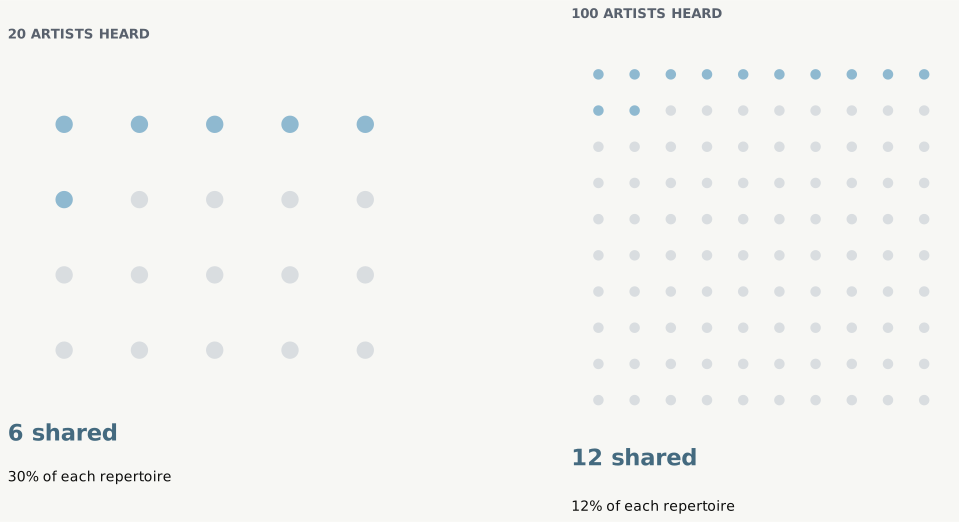
Illustrative model, not measured market data. Blue dots are shared artists. Both listeners are assumed to have equally sized repertoires in each scenario, so relative overlap is the shared count divided by repertoire size.
Both statements can be true: we share more artists than before, and most of what I listen to is different from what you listen to. Put the findings together, and the apparent contradiction disappears. Personal variety can increase. Absolute overlap can increase. Top-hit market share can decline. The denominator model shows how all three movements can coexist.
We may share more music while sharing less of our music.
Shared music does not have to disappear for the mainstream to feel smaller. A song can be known across several groups while occupying less of each group's total musical life. Two people may recognize the same artist but encounter that artist through different songs, playlists, scenes, memes, or levels of engagement.
The sealed-bubble metaphor collapses two separate changes into one. Less hit concentration describes the market. Less shared music would describe relationships between listeners. The first cannot stand in for the second.
It also changes the meaning of scale. When the common center explains less of total listening, a large audience can accumulate inside one part of the culture without traveling evenly through the rest. One number can tell us how much consumption happened, but not how broadly the artist exists in public awareness.
IV. Everyone's famous somewhere
Luminate's Artist Awareness research measures the percentage of U.S. consumers age 13 and older who recognize an artist by name or image. Its findings show how differently sized the same artist can appear when the denominator changes.
Playboi Carti and Lorde each had 43 percent awareness among Gen Z. Across the overall population, however, Carti's awareness was 17 percent and Lorde's was 40 percent.
One youth metric, two different public footprints
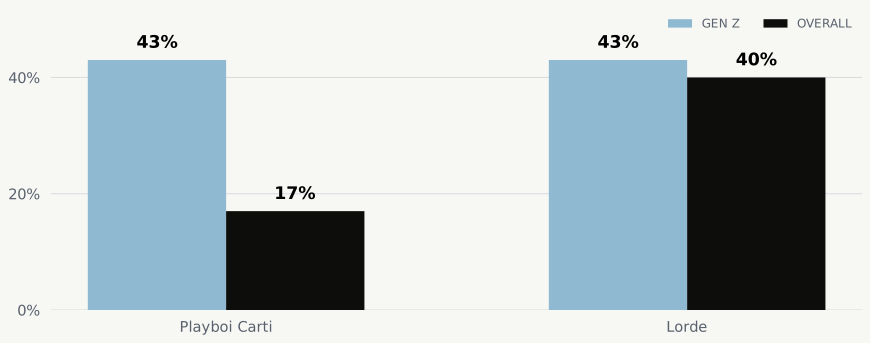
Source: Luminate Artist Awareness6, January 2026. Awareness is the share of surveyed U.S. consumers age 13 and older who recognize an artist by name or image.
Inside one generation, the artists appear equally recognizable. Outside it, they have radically different public footprints. Morgan Wallen provides another version of the puzzle. Despite extraordinary streaming volume and sustained chart performance, Luminate measured his overall U.S. awareness at 37 percent. That is substantial recognition, but far from the universality his streaming position might suggest. Streaming numbers accurately describe consumption on a platform. Public fame is a different dimension of scale. “Big” increasingly requires a denominator.
Big among whom?
- Gen Z or the general population?
- Spotify listeners or radio audiences?
- Hip-hop listeners or music consumers overall?
- A global audience or a few concentrated cities?
- Millions of casual listeners or a smaller group of highly committed fans?
These are not rival definitions waiting for one winner. They describe different achievements. Consumption tells us how much listening occurred. Awareness describes how widely an artist is recognized. Demographic penetration shows where that recognition is concentrated. Fan intensity describes how deeply an audience cares. Geographic reach shows whether demand travels across markets.
An artist can be enormous on a DSP, inside a generation, within a genre, or among a concentrated fan community without becoming equally recognizable across the general population. That is what Everyone's Famous Somewhere means. It is not that every artist is literally famous. It is that fame can now reach enormous scale inside one part of the culture without moving evenly through the rest.
The Luminate examples also suggest that broader fame is associated with exposure across more contexts. Sabrina Carpenter's awareness rose alongside radio airplay. Jelly Roll's awareness increased from 27 percent in 2023 to 63 percent in the second quarter of 2025 during a period that included television, wrestling, and acting appearances. The pattern is associative, but it makes one distinction clear: broad recognition and DSP consumption are separate achievements.
For the music business, the implication is not the familiar slogan that streams are not everything. It is that artist scale has become harder to summarize with one number. A brand evaluating public recognition, a label measuring release consumption, a festival assessing relevance within a scene, and a promoter estimating demand in one city are not asking the same question. The correct metric depends on the audience and action being evaluated. Two artists can appear equally large inside one audience and radically different outside it.
The center still exists
The sealed-bubble story is too simple. The mainstream lost share, while streaming gave listeners room to build much larger musical worlds around the common center. Those worlds can become more varied without eliminating overlap between them. Seen together, the pattern is coherent: leading hits can command less of the market, two listeners can still share plenty of music, and enormous streaming consumption does not guarantee universal recognition.
The strange thing about modern music is not that nobody listens to the same artists anymore. It is that listening to the same artist no longer means that artist occupies the same place in everyone's cultural world.

Notes
MIDiA Research, “Has music reached peak fragmentation?” BPI annual UK top-100 audio-stream share data, 2016–2024. Source. ↩
Luminate, 2025 Year-End Music Report, global streaming pyramid. Source. ↩
Hannes Datta, George Knox, and Bart J. Bronnenberg, “Changing Their Tune: How Consumers’ Adoption of Online Streaming Affects Music Consumption and Discovery,” Marketing Science 37(1), 5–21. Published online September 2017. Source. ↩
George Knox and Hannes Datta, “Platform-Guided Consumption Similarity,” June 2022 working paper, author’s publication page. Source. ↩
Spotify Research, “Algorithmic Effects on the Diversity of Consumption on Spotify,” December 2020. The reported association does not establish that recommendations cause narrower listening. Source. ↩
Luminate, “Artist Awareness: Measuring What It Takes to Be a Household Name,” January 2026. Awareness measures recognition by name or image among surveyed U.S. consumers age 13 and older. Source. ↩